

Market making is the backbone of liquid markets.
Without it, spreads widen, slippage grows, and trading becomes inefficient.
Ultimately, it’s what allows end users to perform trades, swaps, lending, or any other economic activity onchain.
On centralized exchanges, professional market makers rely on direct market data feeds and colocated infrastructure to rebalance positions in microseconds.
On Solana, the principle is the same: market makers must continuously update positions across pools at block speed. If they miss a rebalance by even a few hundred milliseconds, they risk quoting stale prices or absorbing toxic flow.
That’s why market making is one of the most demanding use cases for machine-native infrastructure.
However, unlike CEXs, rebalancing positions quickly onchain presents some challenges.
Stale Data and Fragile Execution
To make sure onchain markets function correctly, market makers must be able to:
1. Detecting Shifts in Liquidity
Market makers need to track several events as they happen:
Cross-pool liquidity changes
Token accumulation or migration events
Wallet-level flows that signal momentum
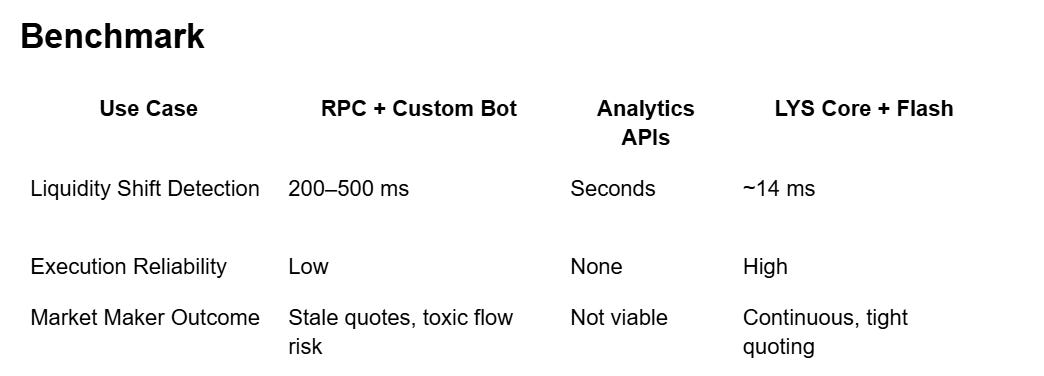
With raw RPC feeds, reconstructing this information requires parsing fragmented swaps, liquidity additions/removals, and transfers.
This translates into hundreds of milliseconds of latency at best.
High latency makes it difficult for market makers to safely fulfill their duties, which pose a systemic risk for the whole onchain economy.
2. Executing Rebalances Reliably
Even when opportunities are detected, execution is still fragile:
Blockhash expiry forces constant re-signing
Congestion drops transactions from queues
Single-path routing to RPCs often fails under stress
Missed rebalances cause stale quotes, which affect the PnL.
Not an ideal scenario for any of the ecosystem participants.
LYS Core: Seeing Flows at Block Speed
LYS Core transforms raw Solana logs into structured trading signals in ~14 ms.
For market makers, this means:
Liquidity migrations reconstructed as coherent events
Wallet clustering to reveal directional flow (e.g. whales rotating positions)
Cross-pool price shifts surfaced as spreads or imbalances
Instead of piecing together fragmented logs, Core provides machine-ready context at block finality.
A market maker doesn’t just see a swap: they see who moved liquidity, from where, to where, and what it means for their exposure.
LYS Flash: Rebalancing Without Failures
LYS Flash ensures rebalances actually land:
LYS Proprietary algorithm allow pre-signed rebalance transactions to remain valid until executed.
Redundant validator routing increases landing probability during congestion.
QUIC fast lanes bypass slower HTTP submission.
Leader schedule awareness ensures transactions are sent to the right validator at the right time.
LYS Flash turns market making into a predictable activity, even during volume spikes.
Case Study: Managing SOL/USDC Exposure
Without LYS:
Market maker detects a liquidity shift on Raydium only after parsing logs.
Detection delay = 250 ms.
Rebalance transaction fails once under congestion.
By the time it lands, price has already moved → stale quote loss.
With LYS Machine OS:
Core surfaces liquidity migration event in 14 ms.
Pre-signed Flash transactions trigger instantly.
Broadcast redundantly via QUIC to multiple leaders.
Rebalance lands in the same block → loss is avoided as the quote remains tight.
Market Makers and Internet Capital Markets
Remember what happened on October 10th?
$19B got wiped out from the market in a single day: the biggest single crypto liquidation event ever.
How did it happen?
As market makers withdrew their bids, the order book became unstable, sellers pushed the price down, and ultimately generated a liquidation cascade.
As you can see, market making is not optional.
It’s the foundation of liquidity, and liquidity is what keeps markets alive.
If machines can’t maintain tight, continuous spreads, traders abandon venues as they become no longer profitable.
With LYS MachineOS, market makers gain:
Real-time visibility into flows
Reliable rebalancing execution
Confidence under congestion
LYS MachineOS can help keep on-chain liquidity provisioning competitive with centralized venues.
Arbitrage proves whether you can capture short-term spread, while market making proves whether you can sustain continuous positions. Together, they sustain healthy, prosperous Internet Capital Markets.
LYS MachineOS delivers both: structured clarity at block speed, and execution that lands every time.